Publication
Minimally invasive capsule-string device enables spatially resolved microbiome profiling across the upper gastrointestinal tractFor clinicians
An office-based test for monitoring EoE activity
The Esophageal String Test® (EST®) measures eosinophil-associated proteins captured from the esophagus to help clinicians monitor EoE disease activity and response to treatment, in the office and without sedation.[1, 2] Samples are collected with the EnteroTracker® collection device and analyzed in EnteroTrack Labs' CLIA-certified, CAP-accredited laboratory.
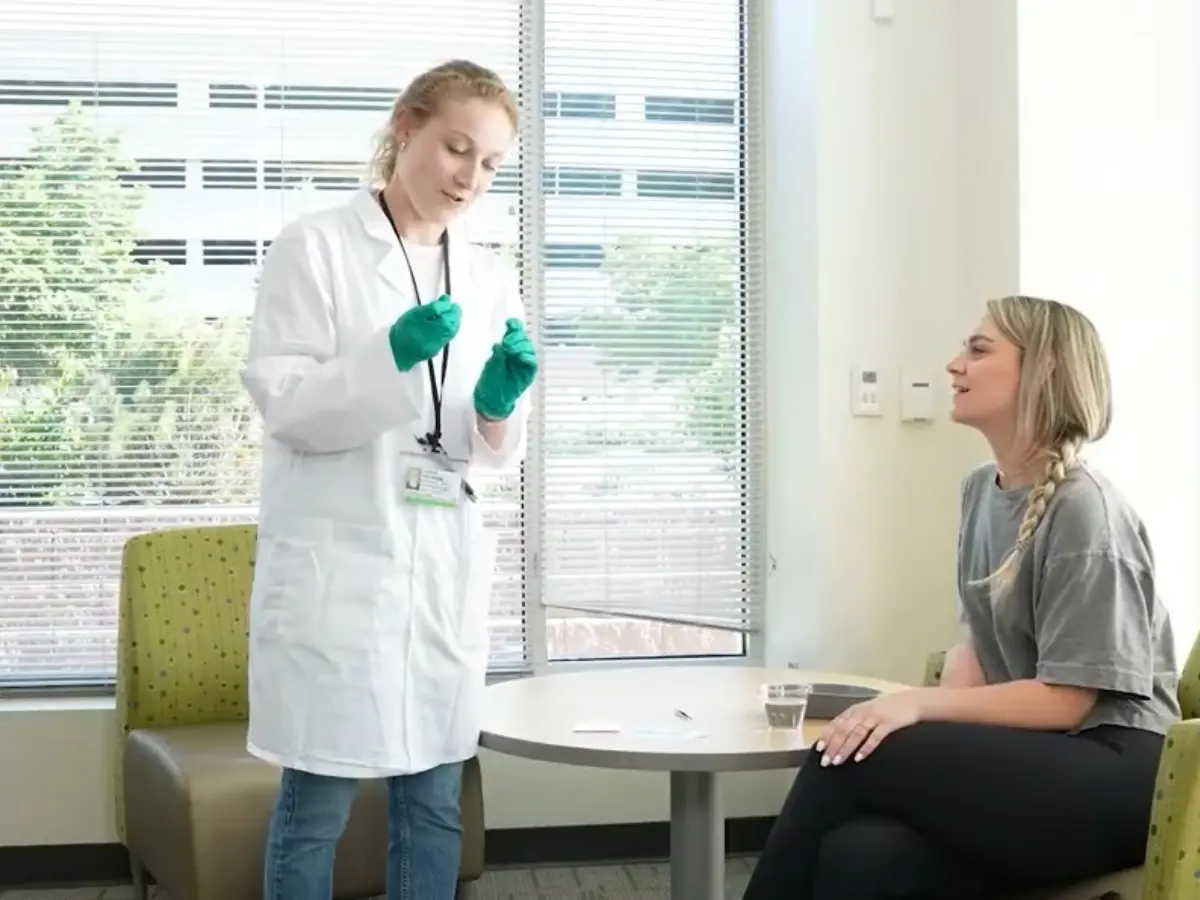
Built around clinical care
One hour,
in the office
The patient swallows a capsule with a thin string, which stays in place for one hour.
The esophageal segment is then sent to our lab, which reports an EoEScore based on eotaxin-3 and major basic protein-1 levels.[1]
Explore our technologyFor clinical confidence
People first.
Evidence alongside.
Explore published work on biomarker-based EoE monitoring and upper gastrointestinal sampling.
Explore the clinical evidenceFrom evaluation
to your practice.
Keep the practical information close at hand.
Explore the full clinical information
In a longitudinal study of children and adults on treatment, EoEScores correlated with biopsy eosinophil counts and distinguished active EoE from treatment-associated remission in 93.9% of ESTs (33 tests in 14 patients).[2]
Learn MoreIn use across allergy and GI practices.
[1]
“Logistically in my office, if I saw a patient—even if it was their first visit—I can literally set it up within five minutes and do the test.”
– Dr. Ray Firstz, allergist, Tanner Clinic, Murray, UT
Webinar with Dr. Firstz
“By offering an alternative tool that eliminates the need for sedation and reduces time away from school or work, patient families have a more accessible option for esophageal testing, and providers still collect necessary data for patient care.”
– Dr. Benjamin Wright, pediatric allergist and immunologist, Phoenix Children's.[7]
Read Full Article“We knew there had to be options to save our patients from having to go under anesthesia in order to obtain results that would tell us much-needed information about their conditions.”
– Glenn T. Furuta, MD, pediatric gastroenterologist; co-inventor of the EST and EnteroTrack co-founder and Chief Medical Officer.
Read Full ArticleWhy The Esophageal String Test®?
- Repeat monitoring: The EST can be repeated during treatment, giving a quantitative EoEScore at each check-in without sedation.[2, 3]
- Fewer sedated procedures.[3]
- More than a decade of published research.[1, 5]
What the evidence shows
In published studies, EST biomarker levels correlated with peak eosinophil counts, endoscopic findings and the same proteins measured in biopsy tissue.[1, 5]
Latest Publications
The Minimally Invasive 1-Hr Esophageal String Test (EST) Monitors Therapeutic Changes in Mucosal Inflammation in Eosinophilic EsophagitisEsophageal Microbiome in Eosinophilic Esophagitis
View All Publications →How EST results compare with biopsy
In children and adults, EST levels correlated with peak eosinophils per high-power field.[1]
Webinar: Shauna Schroeder, MD, MS on EoE Monitoring & Unsedated Endoscopy
During this webinar, Shauna Schroeder, MD, MS, presented information about unsedated endoscopy and monitoring options for eosinophilic disorders, including the Esophageal String Test®. Dr. Schroeder discussed the different types of diagnostic tools that are available, how they work, and when they are used, with a focus on the Esophageal String Test®.
Learn MorePodcast: Esophageal String Test® — Monitoring Tool Use and Development
A patient advocate living with eosinophilic esophagitis (EoE) and a feeding specialist living with EoE who serves on APFED's Health Sciences Advisory Council talk with our lead developers, Drs. Robin Shandas and Steven Ackerman (EnteroTrack co-founders).
Excellent Tolerability in adults and children[1, 3, 4]
Proudly Partnered With
Ready to offer the EST?
Talk with our team about ordering, training and sample shipping.
Contact usScientific References
- Ackerman SJ, Kagalwalla AF, Hirano I, et al. One-hour esophageal string test: a nonendoscopic minimally invasive test that accurately detects disease activity in eosinophilic esophagitis. Am J Gastroenterol. 2019;114(10):1614–1625. doi:10.14309/ajg.0000000000000371. PMID 31567192. View source
- Ackerman SJ, Kagalwalla AF, Pan Z, et al. The minimally invasive 1-hour esophageal string test monitors therapeutic changes in mucosal inflammation in eosinophilic esophagitis. Am J Gastroenterol. 2025;120(1):254–258. doi:10.14309/ajg.0000000000003192. PMID 39503361. View source
- Quinn LA, Andrews R, Bauer M, Nguyen N. Utilization and impact of esophageal string testing in children with eosinophilic esophagitis: a 1 year experience. J Pediatr Gastroenterol Nutr. 2024;79(3):631–635. PMID 39032054. View source
- Lu J, et al. [Full title and author list to confirm.] Ann Allergy Asthma Immunol. 2026. doi:10.1016/j.anai.2026.09.724. View source
- Furuta GT, Kagalwalla AF, Lee JJ, et al. The oesophageal string test: a novel, minimally invasive method measures mucosal inflammation in eosinophilic oesophagitis. Gut. 2013;62(10):1395–1405. doi:10.1136/gutjnl-2012-303171. View source
- Children's Hospital Colorado. Advancing digestive care. Advances & Answers. Article. View source
- Phoenix Children's. Physician-researchers at Phoenix Children's pioneer use of minimally invasive tool to monitor chronic esophageal disease in children. Press release, January 27, 2025. View source